
Table of Contents
ToggleSo, you want to be an Undergrowth Games contributor. You have probably spent countless hours exploring the dense forests, solving the cryptic puzzles, or battling through the beautifully rendered dungeons that this indie sensation has become famous for. Like many passionate players, you have moved beyond just playing the game. You are now looking at the UI and thinking, “I could make this cleaner,” or reading the lore and thinking, “I have an idea for a side quest.”
That itch to jump from consumer to creator is exactly what keeps the indie gaming world spinning. But before you fire off that email or submit your first pull request, let’s pump the brakes for just a second. Being an undergrowthgames contributor isn’t just about having a good idea. It’s about mastering the technical, creative, and—most importantly—the social landscape of a living, breathing project. This guide is your map through the undergrowth. We will look at the hard skills, the soft skills, the brutal realities of feedback, and the massive rewards that come when you finally see your name in the credits of a game thousands of people love .
H2: Defining the Modern Contributor Role
The term undergrowthgames contributor is wonderfully vague, and that is actually its strength. In the corporate gaming world, you are a “Game Designer” or a “Community Manager”—titles that come with strict boxes and specific expectations. In the indie world of UndergrowthGames, the role is fluid. It acknowledges that game development is a chaotic, collaborative art form.
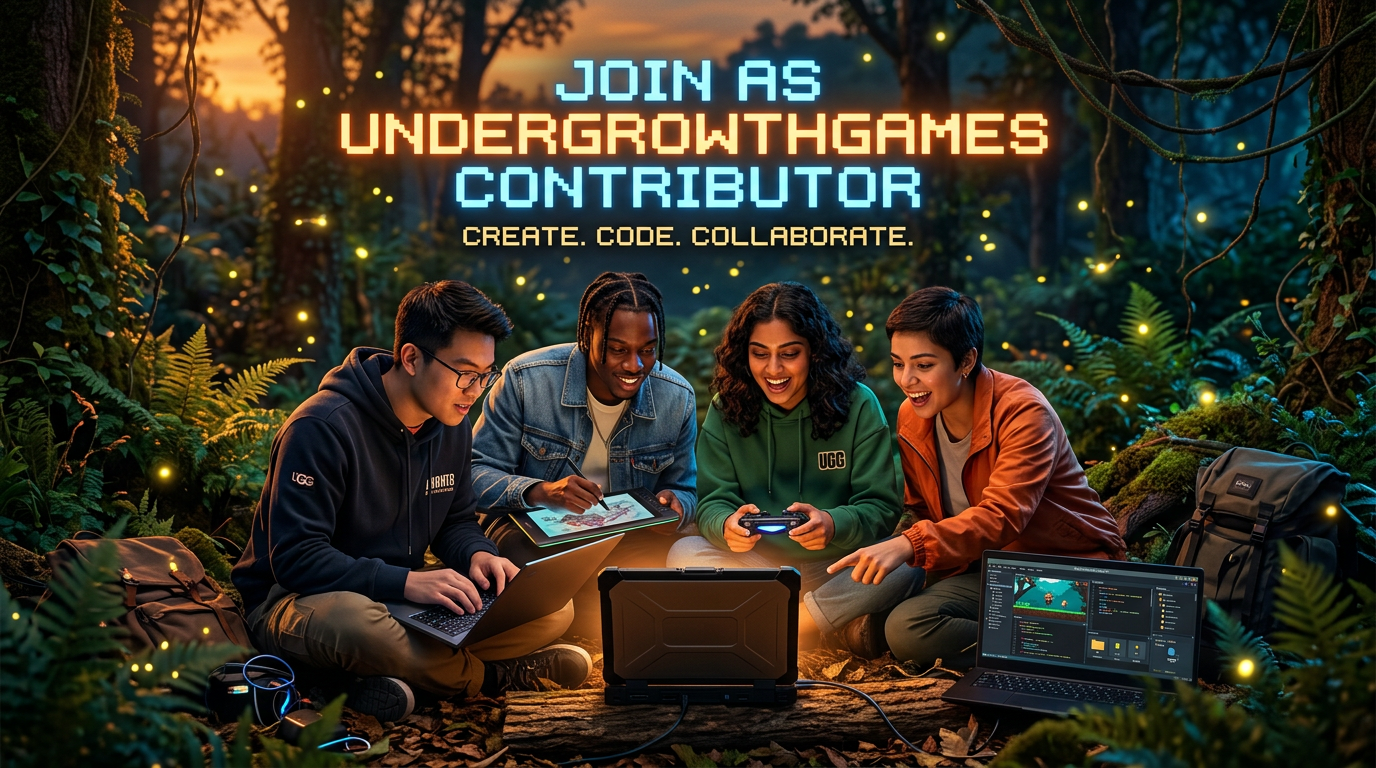
We are not just talking about code here . Of course, the engineers are the backbone of the operation, ensuring the frame rate doesn’t tank when the screen fills with enemies. But the ecosystem of a contributor is much wider. It includes the digital artist who re-textures a mossy rock to look more realistic, the musician who composes the melancholic melody for the swamp level, and the writer who fleshes out the backstory of the vendor who sells you potions.
To be an undergrowthgames contributor is to agree to a social contract. You are agreeing to build something bigger than yourself. It means you have the maturity to look at a system that isn’t broken but could be better, and you have the patience to convince the lead developer why your change matters. It is a role that requires high levels of empathy—for the players who will struggle with your level design, and for the core team who has to clean up if you break something .
H2: The Fork in the Road: Which Path Do You Take?
Before you can claim the title of undergrowthgames contributor, you need to decide where your skills fit best. Trying to force your way into the code repository when you are a narrative writer is a recipe for frustration. The platform thrives because it accepts many different types of labor.
H3: The Code Wizards
These are the logic keepers. If you are a programmer, your goal is efficiency. You look at the game engine and ask, “Is this performant?” You refactor the old enemy AI so that the CPU has more room to breathe. A coding undergrowthgames contributor lives in the issue tracker, squashing bugs that have haunted the community for months .
H3: The Pixel Pushers and Sound Sculptors
Art is what sells the game. Whether you are a 3D modeler making a hyper-realistic sword or a sprite artist creating a charming 2D character, you define the visual language. Similarly, audio contributors are often the unsung heroes. The sound of footsteps on gravel versus wood? That immersion is their doing .
H3: The Lore Keepers and Technical Writers
Here is a secret: Game devs hate writing documentation. They would rather rewrite a physics engine than explain how their inventory system works. This is where the narrative undergrowthgames contributor shines. You write the wiki pages. You edit the dialogue trees. You ensure the grammar in the subtitles is perfect. You are the bridge between the obtuse code and the human player.
H2: Mastering the Pipeline: Git, Issues, and Pull Requests
For any technical undergrowthgames contributor, the first wall you hit is the workflow. You cannot just email a zip file of your “fixed” game folder. You need to learn the tools of the trade. This is usually where passion projects go to die, but it doesn’t have to be scary.
Version control systems like Git are the standard. To be effective, you need to understand the concept of branching. You do not work on the main version of the game. You create a copy, a sandbox. In this sandbox, you work your magic. You fix the bug where the player clips through the floor. You test it. Then, you submit a “Pull Request”. This is your formal application to the core team saying, “Hey, I fixed this, please take my work and put it into the real game.”
The most successful undergrowthgames contributor knows that their first pull request will likely be rejected. Do not panic. This is not a failure; it is a tutorial. The core team will tell you that you forgot to handle a specific edge case, or that your code formatting doesn’t match theirs. They are not rejecting you; they are polishing the work .
H2: The Rude Awakening: Rejection and the “Operational Tax”
Let’s get real for a moment. There is a phenomenon known as the “Operational Tax.” Imagine you spent 50 hours adding a deep-sea fishing mini-game to UndergrowthGames. It is beautiful. It is functional. The lead developer wakes up to your pull request, sighs, and rejects it. Why? Because you just gave them a massive tax.
Now, they have to spend 5 hours reviewing your code. They have to check if your fishing rod breaks the sword combat. They have to format your UI to fit the theme. You thought you gave them a gift, but you actually gave them unpaid homework .
A wise undergrowthgames contributor learns to ask before building. You go to the issue tracker or the Discord. You ask, “Is the fishing mini-game something we want?” If the roadmap doesn’t call for it, you are wasting your time. You need to align your personal passion with the project’s actual needs. Fix what is broken before you build what is shiny.
H2: The Discord Dynamics: Communication is Key
You can be a coding genius, but if you are unpleasant to talk to, you will not last long. The social ecosystem of UndergrowthGames is sacred. The community often communicates via Discord or forums, and this is where a potential undergrowthgames contributor is often made or broken.
Respect the hierarchy. Do not ping the founder because you can’t compile the code. Use the help channels. Ask specific, well-researched questions. “I tried to compile the shaders, but I got error X on line 42” is a great question. “The game is broken, help” is a waste of time.
Furthermore, learn to accept brutal feedback. You will submit your art or code, and a senior contributor will tell you it looks bad. They might even be blunt about it. Your job is to swallow your ego. Don’t defend your mistake; fix it. A mature undergrowthgames contributor knows that the code or art isn’t theirs anymore; it belongs to the game. If the art director wants the sword to be less shiny, you make it less shiny .
H2: The Unsung Heroes: QA and Documentation
You might not be a programmer or an artist. Does that mean you cannot be an undergrowthgames contributor? Absolutely not. In fact, Quality Assurance (QA) testers and technical writers are often the most valuable assets a project can have.
Everyone wants to design the boss fight. Nobody wants to test if the boss fight crashes when the player jumps on a specific box. If you have the patience to break the game intentionally—to walk into walls for ten minutes, to spam inventory clicks until the UI glitches—you are a goldmine.
Similarly, documentation is the least glamorous job. Writing the “Getting Started” guide for new players isn’t fun. But a clear manual reduces the number of “How do I craft a sword?” questions in the chat. If you can read the source code and explain it in plain English, you are functionally acting as a translator. A undergrowthgames contributor who writes good docs makes it easier for the next ten contributors to join the team .
H2: Writing for UndergrowthGames: The Editorial Angle
There is another side to the contributor coin that doesn’t involve code at all. Many people interact with the term undergrowthgames contributor from a media or content creation standpoint. This refers to writing reviews, guides, or news articles for the platform’s publication arm.
In 2026, gaming media is saturated. To stand out as a writing contributor, you cannot just recap a press release. You need analysis. You need a voice. The publication values editors who practice restraint—who write with clarity and avoid hyperbole .
If you want to be a writing undergrowthgames contributor, your goal is to answer the question the reader didn’t know they had. Don’t just write “Game X is fun.” Write “Why the crafting system in Game X respects your time more than its competitors.” You need to blend authority with approachability. You are an expert, but you are also a friend guiding the reader through the noise.
H2: The Art of the Guide and Tutorial
As an undergrowthgames contributor focusing on content, you will likely write tutorials. SEO (Search Engine Optimization) matters here, but not at the cost of readability. You want to write headers that answer specific queries. “How to beat the final boss” versus “A guide to the final boss.”
However, the best tutorials tell a story. They acknowledge the player’s frustration. “Stuck on the Shadow Guardian? Don’t worry, we all were. Here is the cheese strategy.”
Your content needs to be evergreen. Avoid writing “As of this patch…” unless necessary. Provide value that lasts. A stellar undergrowthgames contributor builds a library of assets that continues to drive traffic and help players months after the article is published.
H2: Navigating Ethical Gray Areas
With great power comes great responsibility. An undergrowthgames contributor, whether in dev or media, must have integrity.
For developers: Don’t sneak in Easter eggs that are offensive. Don’t add code that phones home to your personal server. Transparency is key.
For writers: Disclose your biases. If you are friends with the dev, say so. If you received a free copy of the game, that is standard, but if you got paid to write a positive review, that is an ad, not a review. Editorial contributors must maintain the trust of the reader, otherwise, the whole platform suffers.
H2: Building Your Portfolio to Get Noticed
How do you actually become an undergrowthgames contributor? You need a portfolio. But don’t just show me a screenshot of a tree you made in Blender. Show me the tree in the engine. Show me the wireframe. Show me the texture map.
Better yet, show me the problem you solved. “Here is a bug report I filed,” or “Here is a pull request where I fixed a memory leak.” Documentation of process is just as valuable, if not more so, than the final product.
Start small. Do not apply to be the Lead Designer. Apply to fix a typo in the settings menu. Once that tiny, trivial fix is accepted, you have a foot in the door. You are no longer a stranger; you are a proven undergrowthgames contributor. From there, you ask for slightly bigger tasks. Scale your ambition slowly .
H2: Comparing Contributor Archetypes
To truly understand where you fit, it helps to see the landscape laid out clearly. The following table breaks down the primary archetypes of an undergrowthgames contributor and what each role prioritizes.
| Contributor Type | Primary Focus | Key Skill Required | The “Make or Break” Moment |
|---|---|---|---|
| Technical Engineer | Performance & Logic | System Architecture | Optimizing the render thread to handle 100 enemies on screen. |
| Creative Artist | Aesthetics & Mood | Visual Consistency | Matching the color palette of the existing game perfectly. |
| QA Tester | Stability & Replication | Patience & Detail | Logging a 15-step process to recreate a rare crash bug. |
| Narrative Writer | Voice & Clarity | Grammar & Tone | Writing dialogue for a character that doesn’t sound robotic. |
| Community Manager | Sentiment & Flow | Empathy & Diplomacy | De-escalating a forum fight about the new patch nerfing a weapon. |
H2: The Grind of Post-Merge Responsibility
You did it. Your code was accepted. You are officially an undergrowthgames contributor. Congratulations. But the journey doesn’t end when the merge happens. It actually begins.
Now you own that feature. If a new patch two weeks from now breaks your code because the underlying physics changed, you are on the hook to fix it. You cannot ghost the project. Abandonware is the curse of the indie scene.
Being a reliable undergrowthgames contributor means sticking around for the boring part. The launch party is fun; the bug fixing the morning after is the real work. If you prove you can handle the boring maintenance, you earn the trust to build the exciting new features next time.
H2: The Financial Reality: Passion vs. Payment
Let’s talk money. Does an undergrowthgames contributor get paid? It varies.
Many start as volunteers. You are doing it for the love of the game, the experience, and the portfolio piece. However, successful games often implement revenue-sharing models. If the game sells skins or DLC, the contributors who built those systems might get a cut.
Be wary of projects that promise “exposure” instead of money. Exposure doesn’t pay rent. A professional undergrowthgames contributor has a clear conversation upfront: “What is the compensation structure?” If the answer is “nothing right now,” that is fine—as long as you are making an informed choice. Ensure the project has a proper legal framework, perhaps even a CLA (Contributor License Agreement), so you understand who owns the code you write .
H2: The Joy of the Craft
Despite the warnings about taxes, rejection, and hard work, being an undergrowthgames contributor is one of the most rewarding experiences in the indie scene.
There is a special magic when you load up the game and see the change you made. Even if it is just a tooltip fix, thousands of players will see that. You are leaving a mark on a piece of interactive art. You are part of the reason someone smiled when they figured out that puzzle.
The collaborative high of finishing a feature with a team of strangers from across the globe is unmatched. You aren’t just clocking in; you are building a cathedral with friends. The camaraderie, the shared frustration at a bug, and the collective victory when it is squashed—that is the drug that keeps an undergrowthgames contributor coming back for more.
H2: Quotes from the Trenches
To give you a taste of the real mindset inside the industry, here are some exemplary quotes that define the spirit of contribution.
“The most expensive code in game development isn’t the code that takes the longest to write. It’s the code that requires the core team to stop their momentum to fix, integrate, or decipher your undocumented logic.”
— A reflection on the “Operational Tax” of unsolicited contributions.“Game developers absolutely hate writing documentation. If you can read the source code and write a clear, concise wiki page, you’re worth your weight in gold.”
— The battle cry for Technical Writers in the gaming space.“Readers are drawn to content that helps them understand changes in the gaming industry, evaluate products before spending money, or navigate new systems.”
— The editorial mandate for content-focused contributors.“UndergrowthGames positions itself as a digital destination for gaming and technology coverage, blending reviews, commentary, and broader industry discussion.”
— Defining the platform’s unique voice in a crowded market.
H2: The Final Checklist
Before you rush off to start your journey, let’s run a quick checklist. Are you ready to become an undergrowthgames contributor?
Do you have a thick skin? Can you handle someone rewriting your code or redlining your article without crying?
Do you have the time? Can you commit to at least checking the Discord or the repo once a week?
Do you have the humility? Are you willing to start with the dirty work—the typos, the bugs, the tutorials—before you get to design the cool stuff?
If you answered yes, then the community is waiting for you. The undergrowth is dark and tangled, but with the right tools and the right attitude, you can help light the way for everyone else.
H2: Frequently Asked Questions (FAQ)
H3: What exactly is an undergrowthgames contributor?
An undergrowthgames contributor is any individual who adds value to the UndergrowthGames ecosystem. This includes software developers fixing bugs, artists creating assets, writers producing guides or lore, QA testers reporting issues, and community members helping other players. It is a broad role that prioritizes action over titles .
H3: Do I need to know how to code to become a contributor?
Not at all. While coding is a major part of game development, there are many non-technical roles. An undergrowthgames contributor can focus entirely on writing documentation, managing social media accounts, creating sound effects, or even just organizing the bug report forums. If you can communicate well or have an eye for detail, there is a spot for you .
H3: I submitted my work but it was rejected. Does that mean I failed?
Absolutely not. Rejection is the standard first step for any serious undergrowthgames contributor. Projects have specific style guides, performance standards, and roadmaps. If your Pull Request is rejected, read the feedback carefully. The core team is trying to teach you their standards. Fix the issues and resubmit. Persistence is the key trait of successful contributors .
H3: Will I get paid for my contributions?
It depends on the specific project and the agreement in place. Many indie projects start as passion projects or “open source” style collaborations where payment is not guaranteed. However, successful games often implement tip jars, bounties for specific issues, or revenue sharing. A wise undergrowthgames contributor discusses payment expectations before starting a large task, not after .
H3: How do I find tasks to work on?
Look for the “Issue Tracker” on the game’s repository (like GitHub) or a “Task Board” in their Discord. Look for labels like “Good First Issue” or “Help Wanted.” These are tasks specifically curated for new contributors. Do not try to solve the hardest problem first. An undergrowthgames contributor starts small—fix a typo or a minor bug—to build trust and familiarity with the workflow .
H3: What is the “Operational Tax” and why should I avoid it?
The “Operational Tax” is the hidden cost of unsolicited features. If you build a massive new system without asking the project leads first, you force them to spend their time reviewing and fixing your work. An effective undergrowthgames contributor always communicates their intentions before writing a single line of code. They ask, “Do we want this?” before they build it, saving everyone time and frustration .
H3: How do I get better at contributing?
Review other people’s work. Look at the closed Pull Requests or published articles from senior contributors. See what they changed and why. Additionally, ask for feedback on your own process. A growing undergrowthgames contributor is always learning, not just about code, but about collaboration and communication.
Conclusion
Becoming an undergrowthgames contributor is a journey of evolution. It transforms you from a passive consumer of entertainment into an active architect of digital worlds. The path is not always easy. It is paved with rejected pull requests, misunderstood intentions, and the occasional bout of Imposter Syndrome. Yet, the rewards—the skills you learn, the community you join, and the tangible impact you make—far outweigh the struggles.
Whether you choose to dive into the code, pick up a paintbrush, or start writing that wiki page, remember that consistency beats intensity. Show up, do the work, and respect the team. The undergrowth is waiting for you to leave your mark. Are you ready to step inside?
You May Also Read
The Hidden Costs of Indie Game Development
How to Optimize Your Gaming PC for Indie Titles
A Deep Dive into UndergrowthGames Community Management
Mastering the Art of Video Game QA Testing
The Best Tools for Aspiring Game Sound Designers